Showing posts with label Britain vs Russia. Show all posts

Monday, 27 May 2013

Baltic Campaign part 3: Siege of Pori

With the losses suffered by the Russian army in assualting the Tomio ridge, the decision was taken by General Roman to withdraw through Finland to the Russian earthwork fort of Pori where he was prepared to sit the summer out and await the winter when the British would again have to retire to Stockholm. Roman was confident that the supplies in Pori could last his force for a year and also that his artillery was still numerous enough to deal with a near equal number of British artillery and siege works. With the arrival  of Danish infantry through the blockade  he was still more confident that the earth fort at Pori could win him the war.

However when Lord Blantyre, chasing the Russian rear through Finnish spring, finally arrived at Pori he saw the danger and decided a direct, swift assualt was all that could seal his victory. So with the newly arrived 28th he set about opening an artillery bombardment to silence the Russian guns whilst the infantry (with no pretence at siege works) charged up hill across open ground and a river bed towards the Russian fort with only their hands, feet and a few ropes to get them over the walls. The assualt seemed set for a blood bath

Lord Blantyre's expeditionary force

-2nd Battalion, 42nd black watch regiment of Highlanders
Two companies: 48 men
-16th Bedfordshire regiment of foot
One company: 24 men
-28th North Gloucester regiment of foot
Three companies: 72 men
-Royal Horse artillery
four 8pdrs.


Brigadier Roman's invasion force

-Pavlov grenadiers, 1st and 2nd companies
two companies: 48 men
-Danish Infantry
One company: 24 men
-Foot artillery
three 6pdrs
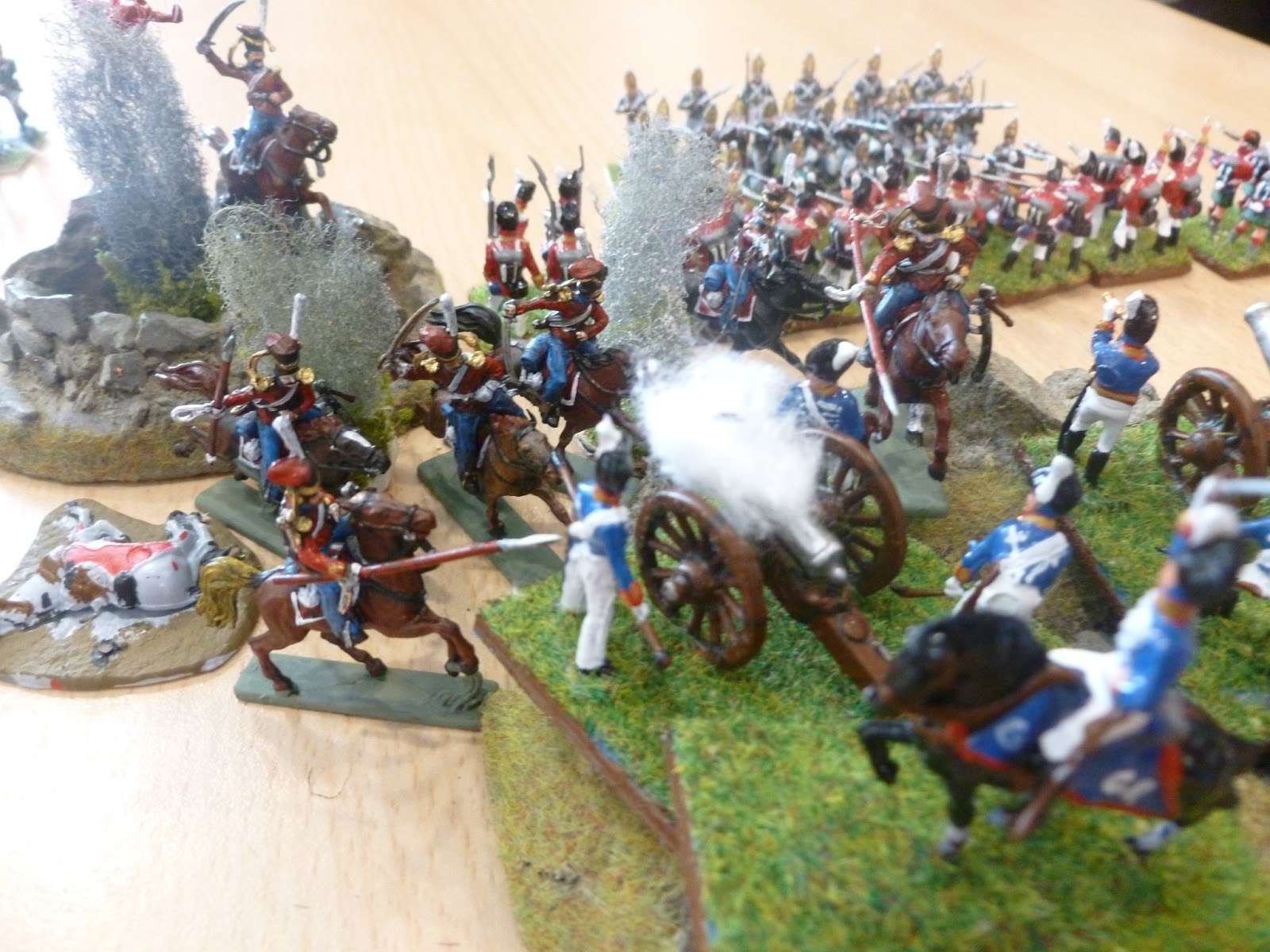
Blantyre, mounted above his army, led the way as the infantry advanced in dense columns, covered by Parkhill's battery of horse artillery. The open ground was a great distance to cross and would need to be covered quickly before the Russian guns and musketry took their toll.

A Russian engineer officer on watch duty spies the advancing British in the late morning and reports the seemingly suicidal assault to his senior who, with disbelief  at the British stalwart tactics, order the artillery to open fire!

The first shot from the fort tears into the heart of one of the Black Watch's columns whilst still stationary, sending the remaining highlanders fleeing in all directions, but leaving the other redcoats as resolute as ever.

Blantyre galloped forward, onto the bridge between the opposing forces, whilst the columns bean their charge. However the uneven ground of the river bed meant that only three out of the five remaining company columns reached the earthworks leaving the 28th and 42nd unsupported.

As the columns came up against the walls the lead men levelled their muskets over the works at the defenders, but with the thin lines of Pavlov grenadiers and the light but close 3pdr cannons pointing their direction the stranded companies seemed lost.

As the first company of the 28th attempted to make ground on the earthworks, a close range, file length blast from the nearby 3pdr pop gun ripped through the ranks. Unable to control the few remaining men, both officers and NCOs fled  the fortress walls with their dirtied and blooded men.
But the 42nd had much more luck as the front men peppered the Pavlovs with musketry taking their toll on them whilst making good use of the earthworks cover.

On the far left of the assaulting British the 28th attempted to make a rush across the lower hurriedly constructed defences held by the Danes and Pavlovs, but they were soon countered by the Pavlovs bayonets, denying them entrance. Meanwhile the Danes rushed from the safety of their defences to flank charge the Gloucesters inflicting heavy casualties. The few remaining redcoats with their Major down ran back to their lines. So far the British assault seemed to be a drastic failure and one that could lead to Blantyre's ruin, it had been a gamble and it did not appear to have paid off.

Seeing the Danes out from their defences and exposed, Major Parkhill commenced battery fire on the company. The shots struck well delving into the redcoated ranks and inflicting severe losses. The remnants of  a once glorious company retired, the fight gone from them. Heads would roll in the Russo-Danish relations office.

With half his infantry gone to only a single company of Roman's, Blantyre decided on a last desperate push for death or glory. He rallied his three remaining companies and directed them at a single point in the Russian fortifications, personally leading them up against the bulwarks.
Having been hard at work, the sappers with axes and spades and the men with their bayonets, the 42nd finally kicked, shoved and hauled their way over and  through the earthworks before them, bursting straight into the side of an artillery position and easily overrunning the gun.

With the Bedfords pushing to force their way into the most heavily defended and pallisaded gun position, the gunners took action, plunging round shot down the files of the oncoming troops and causing desperatly high casualties. At the same time a detachment of Grenadiers opened an enfilading volley from line into the heart of the disordered redcoats. The Bedfords were almost completely annihilated with few men uninjured.

But even as the Bedfords ran, the remaining 28th had torn their way through the earthen walls and overrun the central, heavily fortified artillery piece. The 42nd, meanwhile, had charged straight into the assembled line of Pavlov grenadiers causing considerable casualties. Several of the Pavlovs tried some pot shots at Blantyre but missed and with that Blantyre called for a halt in the fighting.
Roman and Blantyre met to discuss terms while the men halted in their columns. Blantyre believed he would have to retire, but at the same time believed he could end the assault now with his superior artillery. Roman considered his position strong, being able to boast the same number of infantry (superior quality) as the British but could not match they're artillery being left with only one gun. Blantyre decided to offer Roman a surrender in which the Russians handed over Pori and any claim to Finland in return for an Anglo-Swedish promise not to march on St Petersburg. Roman however was hesitant.

To persuade him Parkhill opened bombardment on one company of the Pavlovs arrayed beyond the safety of the earthworks, demolishing their formation. The armistace was broken and the fighting continued but the damage had been done and General Roman was in a bad place.

The 42nd broke as the Pavlovs retaliated with a volley, but the Gloucesters led by Blantyre quickly secured the last Russian gun. Roman was forced to unconditional surrender having but one company left and being faced by the 28th and Parkhill's artillery. 

Pori surrendered along with the Russian army. Roman agreed to turning his army over to fighting the French and with his army turned the Tzar soon followed. 
With the arrival of Blantyre in Sweden had come the ejection of the Russians from Finland and the turning of the Russians against the French. For his part in the war Lieutenant Colonel Robert Walter Stuart, lord Blantyre, of the 2/42nd was promoted to Brigadier General and Colonel McDowell was given much credit.

Wednesday, 6 February 2013

Baltic campaign part 2: 2nd battle of Tomio

February 5th 1809. On the same ridge east of Tomio where a week before they had indecisively clashed, Lord Blantyre and Brigadier Roman again viewed each other across the frost bitten Finnish landscape. Both had brought up more troops and resupplied their lines and troops, and Roman was again ready to mount an assault on the British position.

This was our second attempt at this game (having had to declare the last indecisive despite heavy slaughter since I had to leave the sports centre cafe where we have our games early in order to catch a train.) This week we had our full time and the same forces again. It would be the result of this conflict that would either send the Russians flying back over barren Finland in defeat or marching on through Sweden's coastal cities. 

Lord Blantyre's expeditionary force

-2nd Battalion, 42nd black watch regiment of Highlanders, Grenadier (captain William Jenkins and light (Captain Angus Firthson) Companies.
Two companies: thirty eight men, one sergeant Colour's ensign, piper and drummer.
-16th Bedfordshire regiment of foot, 1st company.
one company: twenty men, two musicians and two sergeants
-Royal Horse artillery, two 8pdrs.
five crewmen and one master gunner


Brigadier Roman's invasion force

-Don Cossacks of the royal guard, 1st and 2nd troops.
two troops: seven lancers, five troopers and two captains
-Pavlov grenadiers, 1st and 2nd companies
two companies: forty four men, colour ensign, Captain, fifer and drummer
-Foot artillery, two 6pdrs
ten crewmen, two master gunners and a caisson


Both armies deployed similarly to the last time they had met, but this time the British had secured their flanks against charges by the Don Cossack lancers of the guard. The Russian elite too were deployed as they had when previously attacking the Tomio ridge, though they had managed to come closer than they had last time when launching the assualt

But before Roman could order the charge, Major Parkhill's battery was opening fire on the massed companies of mitre capped Pavlov grenadiers. However the gunners merely proved to be testing their ranges as both shots missed their targets completely.

Unable to manouvere around the flanks of the British, the 1st troop of Guard Cossacks now levelled their lances and charged over the rocky escarpment in the centre of the ridge and on towards Parkhill's elevated battery. But as they came on the British horse artillery loaded their gun with cannister and sprayed the charging horsemen with grape as they crested the hill.

Though within sword's breadth of the crewmen the casualties, the Cossacks, frightened by the close range shooting and shaken by the loss of life, scarperd back the way they had come and clean off the battle field, trailing their dead behind them.

Only slightly concerned by the loss of one troop of their cavalry, the Pavlov grenadiers now charged, in column, up the hill, supported by artillery fire. The artillery, like their British counterparts, shot wide and both round shots tore harmlessly into the ground.
But despite the failed bombardment the grenadiers charged on. The 2nd company charged with fixed bayonets for the Bedfords. However the redcoats fired a hurried volley down the line before counter charging the column in line.

 Despite their heroic reaction and their defensive position, the Bedfords took by far the worse of the ensuing combat losing more men than they inflicted in the hand to hand and becoming disordered as the steady Russian column bulldozed its way up the slope.

But the British took a harsh revenge on this successful column, the grenadier company of the 42nd launching a ferocious highland charge upon their flanks.
Parkhill with his range now sorted and seeing the threat posed to the highlanders' flank by the enemy lancers now readied his guns and took a couple of long shots at them. One of these struck home and sent horsemen scattering in all directions. The lucky shot broke the guard lances, all show and not for blow, and they followed their other troop from the field.

 On the other flank of the British positions, Lord Blantyre ordered the other highlanders into a charge on the 1st company of Pavlov grenadiers, halted on the slope in column. The redoubtable Russian columns were now surrounded and both subjected to terrifying highland charges tipped with cold steel.

The 2nd company of Pavlovs took an appalling casualty count compared to their last  successful round against the Bedfords. Eventually the small group left standing in column fell out in disarray, however these were the mitre topped elite of the Russian army and they would not run at such things.

 On the British left the combat was going just as well, the highlanders taking out bit chunks of the opposing column whilst taking but a single casualty and leaving the enemy disordered but again the Pavlovs did not flee and continued to stand.

Both units of Pavlov grenadiers, though heavily outnumbered, outflanked, outgunned and ousted in combat nevertheless retained the good order and refused to flee despite such heavy losses scattered across the slope of the ridge. The British in their turn shrugged off the casualties attributed to the Bedfords and continued to stand, holding the position.

 But the Russians soon got their revenge, firing an enfilading artillery shot at rather close range into the flank of the highland grenadiers. But the 42nd, imbued with success, stood and continued battling against the Russians' flank.

The other Russian 6pdr pop gun fired on the Royal horse artillery's battery, severing through a crewman with a round shot and sending his blood and two separate parts flying across the gun's trail.
But it was not enough and in the final round of combat the British line broke both attacking columns, sending them flying down the hill and far away, the only small consolation being the destruction of the Bedfords.

Not ready to admit defeat to the kilted British, and armed with but two artillery pieces, Colonel Stanislas of the Don Cossacks of the guard, came out with sabre drawn to issue a duel against lord Blantyre. Blantyre accepted the colonel's challenge and as such both men rode out to confront one another in single combat. The bout continued for some time in medieval fashion (in fact the first three rolls in our roll off to see who won ended up being drawn) but in the end Blantyre retired, injured. But the British army did not recognise Cossack honour or custom and as such the Russians retreated.

The Russians had no close hand supply posts south of Tomio and as such Blantyre, still wounded, followed up their retreat as far as Kokkoa where, once again, he would meet Brigadier Roman in battle and, he hoped, push him yet further south to reclaim Finland before the next winter fell.

Tuesday, 29 January 2013

Baltic Campaign part 1: 1st Battle of Tomio

Britain and Russia have been at war for almost two years since Britain's attack on Copenhagen. However at the end of last winter the Tzar's forces marched West and into Swedish controlled Finland. Russia was supported in this by the French, many of his armies held up by French gold, and most of Europe, it being practically under French control. But Britain was not going to stand by and see their Baltic ally, Sweden, destroyed by the combined forces of Russia, Denmark and France! But over the last year, despite British naval success against the Russians, the Swedes have suffered defeat after defeat and now most of Finland has been annexed by Russia. Not withstanding this, Colonel Kevin McDowall (a leading light in Whitehall and  horse guards) suggested to Portland that an expeditionary force be compiled and sent to aid the failing Swedish forces. Lieutenant Colonel Robert Walter Stuart, lord Blantyre, of the 2nd battalion, 42nd highland regiment was chosen for the mission. He landed in Sweden just before the ice froze and wintered in Stockholm. The new year saw him marching north to Tomio, the Russians next destination.
The 11:55am, 29th January saw a Russian army commanded Brigadier Roman advancing on Tomio. Blantyre's force formed a line two deep along a ridge running north wards only a few miles to the east of the town.
Lord Blantyre's expeditionary force

-2nd Battalion, 42nd black watch regiment of Highlanders, Grenadier (captain William Jenkins and light (Captain Angus Firthson) Companies.
Two companies: thirty eight men, one sergeant Colour's ensign, piper and drummer.
-16th Bedfordshire regiment of foot, 1st company.
one company: twenty men, two musicians and two sergeants
-Royal Horse artillery, two 8pdrs.
five crewmen and one master gunner


Brigadier Roman's invasion force

-Don Cossacks of the royal guard, 1st and 2nd troops.
two troops: seven lancers, five troopers and two captains
-Pavlov grenadiers, 1st and 2nd companies
two companies: forty four men, colour ensign, Captain, fifer and drummer
-Foot artillery, two 6pdrs
ten crewmen, two master gunners and a caisson


The battle commenced at 12:13 and lasted precisely eighteen minutes.

Command of the British army was divided between Lord Blantyre, commanding the infantry holding the ridge, and Major Hugo Parkhill of the Royal horse artillery, in command of the battery on the rocky knoll just a bit back from the thin red line.

As the Russian infantry prepared to advance up the hill in lines similar to those used by their opponents, Parkhill's battery opened fire upon the 2nd company. However only one of the roudshots hit, the other flying long but narrowly missing brigadier Roman, slicing through the ranks to send a man soaring. However being the steady Pavlov grenadiers of the mitre cap they resolutely ignored the barrage.

It was now that the Russian army came on in earnest, the 2nd company of grenadiers marching staunchly up the ridge to within musket range, whilst the 1st charged towards their foes, only stopping when the order to open fire reached them.
On the British right one of the troops of Don Cossacks charged up the flank of the line and swept to attack the 42nd light company, who quickly formed square to deliver closing fire. On the left the cossacks penetrated round the back of the British lines, heading towards Parkhill's battery.

The 1st company of Russian grenadiers now opened fire, their muzzles almost touching those of their foes, but most of the shots misfired and many missed entirely, the 42nd suffering only minor casualties.

The Cossacks, armed with lances, perfect for square busting!, thrusted and shot at the highlanders trying to break through their firm ranks. But the highlanders returned as good as they got, firing off their muskets at close range upon the cavalrymen. In the end the cossacks broke, having taken heavy casualties from the redcoats and completely unable to break the square. However the highlanders had also sustained heavy losses and thus, fearing that they had ceased to be effective as a fighting force, they too retired from the field.

The Russian artillery, readily supplied by their ammunition caisson and under the scrutiny of the brigadier, opened fire on their opposing battery, their troops all having just charged into combat. But the elevation was two high for the 6pdrs to meet and the shots all failed to hit.

The British artillery, ignoring the failing Russian cannons, opened fire at quite close range upon the remaining Cossacks charging towards them. The shots tore through their ranks and halted the cavalrymen in their tracks.

The Cossacks fled back behind their own lines to attempt to rally themselves, whilst the 42nd grenadiers opened fire on the Pavlovs, causing considerably more damage upon the Russians then they had received themselves.

The Russians, unable to shift the red coated soldiers from the ridge through simple musketry, charged into combat. A long line formed across the bridge as bayonets hacked and stabbed away through the smoke.

On the right the Pavlov grenadiers came off considerably worse than the 16th Bedfords, suffering double the casualties of the redcoats, and eventually to cheers of Britannia the Russians bolted down the slope as fast as they could, tearing off after the fleeing Cossacks.

The combat was over and on the right the Bedfords were victorious, having only fought native tribesmen for the last few decades, now they had seen off Russia's elite. But on the left the Pavlov first company, colours flying, saw off the 42nd grenadiers, their colours still held aloft as they scattered from the field. Here the battle ended, both sides ground down to a stalemate. The 16th prepared to fall back on the knoll and make their stand, but the Russians were too sane to push on. The British still held the ridge, but were in no position to follow up their victory and push the Russians back. It was a sour ending and Tomio would yet again be a battlefield